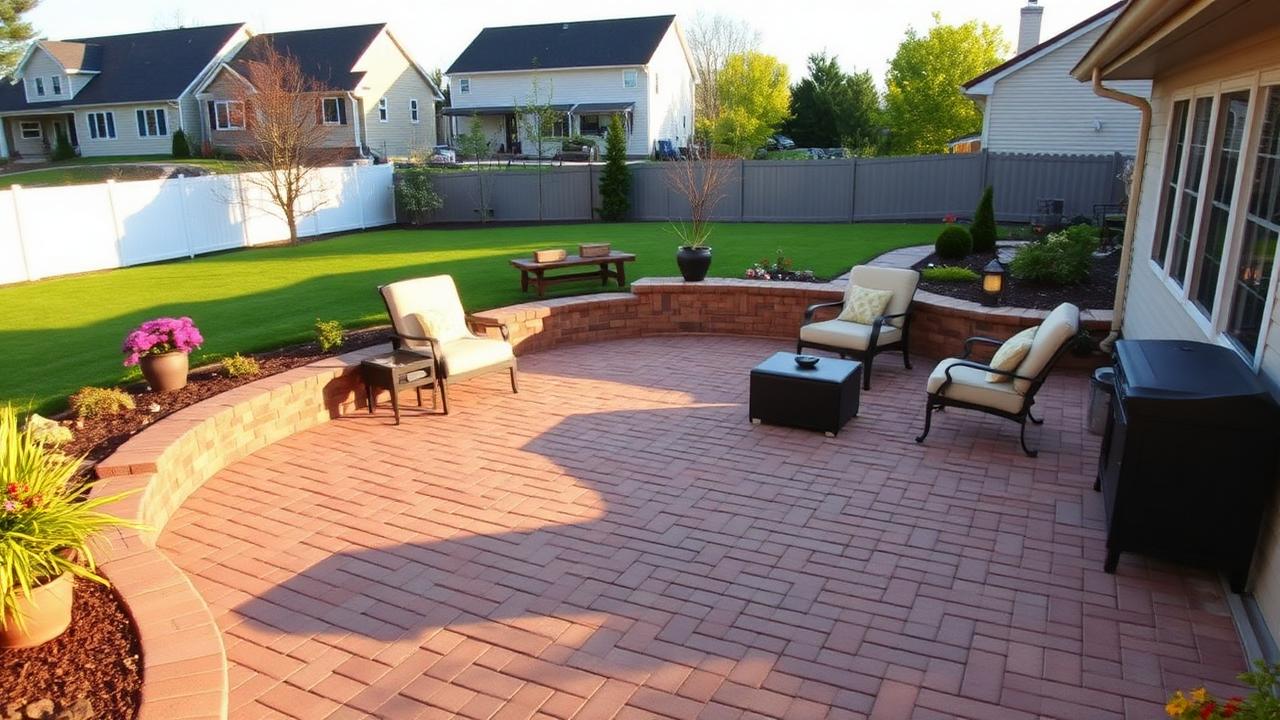
Both materials can last decades — but Ohio's freeze-thaw cycle treats them very differently. Here's how we help homeowners decide between pavers and poured concrete.
It's the question we hear more than any other in the hardscape side of the business: pavers or poured concrete? Both materials can build a beautiful patio, both can last decades, and both have a place in Knox County backyards. The decision usually comes down to four things — freeze-thaw behavior, repair cost, design flexibility, and how much you care about resale. Here's how we walk new clients through it.
The base is most of the patio
Before we talk material, it's worth saying that the base under the patio matters more than the surface. A 4-inch concrete slab on poorly compacted clay will crack just as fast as pavers will sink. A 6-inch limestone base, properly graded for drainage and compacted in lifts, is the foundation that lets either material last 30 years instead of five. If a contractor quotes you a number without asking about base depth or drainage, that's the conversation worth having.
Cost: what you pay now, and what you pay later
In central Ohio, a basic broom-finish concrete patio runs roughly $8 to $12 per square foot installed. A standard concrete paver patio runs $14 to $22, and natural stone or premium pavers push higher. So if you're comparing pure upfront cost, concrete wins by about 30 to 50 percent.
The catch is the second number — what it costs when something goes wrong. A heaved or cracked concrete slab is almost always a tear-out and replace job. A sunken paver gets lifted, regraded, and reset — usually in an afternoon, for the cost of an hour or two of labor and a bag of polymeric sand. Over a 25-year horizon, pavers tend to cost roughly the same as concrete and often less.
Freeze-thaw: the thing that breaks Ohio patios
Knox County averages about 100 freeze-thaw cycles a year. Every cycle, water trapped in any porous material expands roughly 9% as it turns to ice. That's why concrete cracks, asphalt potholes, and brick spalls in this climate. A paver patio handles freeze-thaw by design — the joints between pavers flex, expand, and contract independently. A concrete slab is one rigid plane. It will eventually crack. The question is where and when.
Well-installed concrete with proper control joints, fiber reinforcement, and an air-entrained mix will crack on the lines you want it to crack on, which is the whole point of control joints. Poorly installed concrete cracks wherever it feels like. Either way, in Ohio, you're getting cracks. The honest version of the conversation is whether you'll mind them.
Design: where pavers pull ahead
Concrete is rectangular. You can stamp it to look like stone, you can color it, you can saw-cut patterns into it, and on a small budget those are good options. But every stamped concrete patio in a Knox County neighborhood looks roughly like every other stamped concrete patio.
Pavers let you do things concrete can't: curved edges, color blends, contrasting borders, circular fire pit insets, and seamless transitions into Versa-Lok retaining walls and seat walls made of the same product family. If you've ever seen a backyard where the patio, the steps, the wall, and the fire pit clearly belong together — that's almost always a paver build.
Repair: the long-term reality
When a tree root lifts a paver, we cut the root, regrade the affected area, and reset the same pavers. The repair is invisible. When a tree root lifts a concrete slab, the crack runs the length of the patio and the repair options are limited to mudjacking (sometimes works), patching (always visible), or replacement. The same is true for utility work — adding a gas line to a future grill, running conduit for landscape lighting, or replacing a downspout drain are all relatively simple under pavers and major events under concrete.
Resale: what buyers see
Realtors in central Ohio consistently tell us pavers add more perceived value to a listing than concrete of the same size. The product simply photographs better and reads as 'custom' rather than 'standard.' That doesn't mean every patio should be pavers — for utilitarian spaces like the slab under a hot tub or the pad beside a detached garage, concrete is the right call. For the main patio off the back door, pavers tend to be the better long-term investment.
When concrete is the right answer
We install both. Concrete makes sense when budget is the dominant constraint, when the patio is purely functional rather than a focal point, or when the homeowner has a strong preference for the modern, monolithic look of a single slab. It's also a good choice for very large surface areas where the per-square-foot savings really add up.
When pavers are the right answer
Most of the time. If you're building a true outdoor living space — patio plus fire pit and outdoor living elements, walls, planters, or steps — pavers are the only material that lets every component speak the same visual language. They also age well: a 15-year-old paver patio looks like a 15-year-old paver patio. A 15-year-old concrete patio looks like it needs to be replaced.
How we approach the conversation
On every consultation we walk the space, talk about how the family actually uses the backyard, and look at how the patio needs to relate to the house, the grade, and the landscape beds. We quote both options when both are reasonable. We don't push pavers when concrete is the right answer, and we don't apologize for them when they're not. The job is to install something the homeowner is glad they spent the money on in year ten — not just in week one.
If you're planning a patio in Danville, Mount Vernon, Howard, or anywhere in Knox County, we'd be glad to walk the yard with you and give you a real number for both materials. Patios and walkways are most of what our hardscape crews do — give us a call at (740) 485-2538.