Trees rarely fail without warning. Here are the five signs we look for when deciding whether a tree can be saved or needs to be removed before it fails on its own.
Trees rarely fail without warning — they usually telegraph the problem for months or years before they come down. The challenge is that homeowners walk past the warning signs every day without registering them. By the time a tree drops a major limb on a roof, a fence, or a parked car, the signs were almost always visible. Here are the five we look for first when evaluating whether a tree can be trimmed and saved or needs removal.
1. Dead branches in the upper canopy
Look up. Specifically look at the top third of the tree. Dead branches in the upper canopy — bare in summer, no buds in spring, gray instead of brown bark — are a strong sign the tree is in decline. A healthy tree pushes its energy to the top. When the top dies back, it's because the roots or trunk can no longer move water up that far. Occasional dead branches in the lower canopy are normal — that's natural pruning as the tree grows past lower limbs. Dead branches at the top are not normal.
If the dead portion is less than about 25% of the canopy, the tree can sometimes be saved with crown cleaning and root-zone care. More than that and we're usually recommending removal.
2. Cracks, cavities, or fungal conks on the trunk
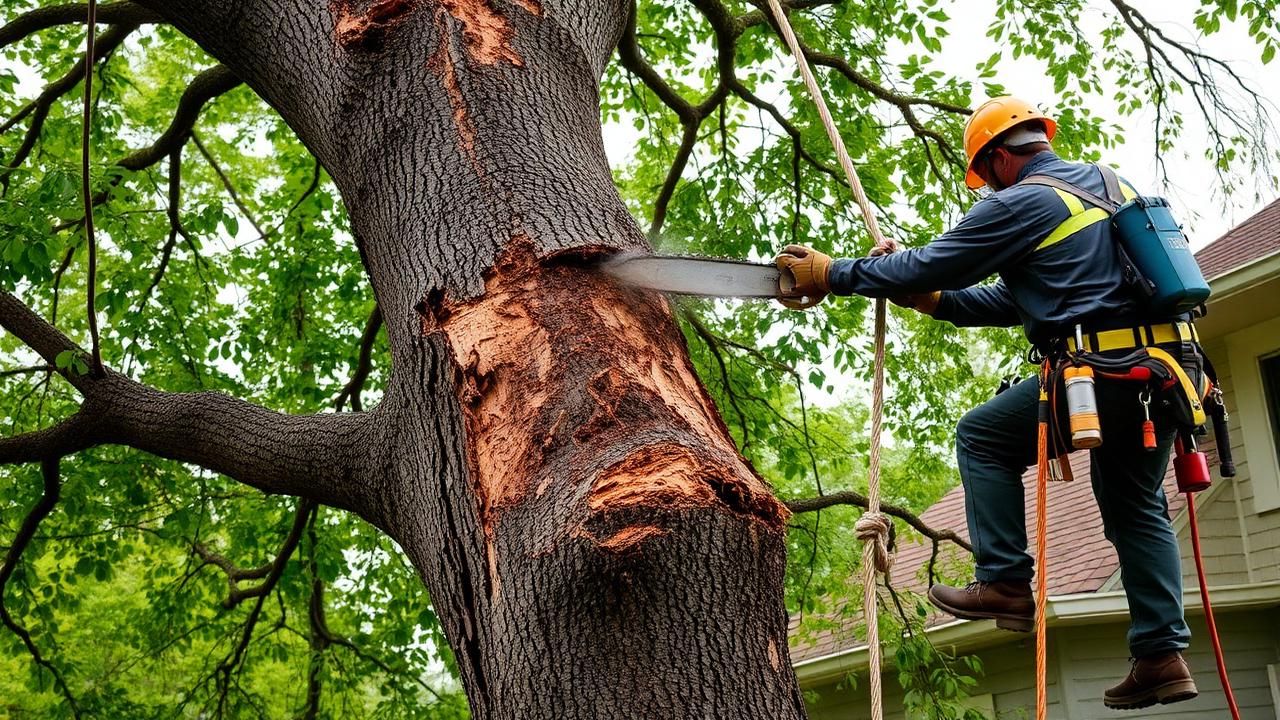
Walk around the trunk and look at the bark. A vertical crack running up the trunk — especially one that opens and closes seasonally — is a structural weakness that won't heal. A cavity where a major branch used to attach is a future failure point. Mushroom-like fungal growths (called conks) at the base or on the trunk are particularly serious; they indicate active wood decay inside the tree, which you can't see from the outside. By the time conks are visible on a trunk, internal decay is typically advanced.
3. Root damage, exposed roots, or fungal growth at the base
The roots are most of the tree, and they're the part you can least see. Look for soil heaving on one side of the tree (the early stage of a root failure), recently severed roots from construction, driveway work, or grading, and fungal growth in the soil around the base. A tree that's been root-damaged by recent excavation — for a new patio, foundation work, or utility trench — may look healthy for two or three years before the failure shows up.
Ohio's clay soils make root damage easy to miss. We routinely respond to failed trees on lots where landscaping or hardscaping was done two summers ago and nothing seemed wrong until the next storm. If you're planning major land work or excavation near mature trees, an evaluation before the work starts is worth the visit.
4. Sudden or progressive lean
Trees that grew with a lean from the start are usually stable — the root system grew compensating for the angle. Trees that have developed a lean recently are not. Signs of a new lean include soil mounding on the opposite side of the lean, exposed roots on the side the tree is leaning toward, and fresh cracks at the base. Any tree that has shifted measurably in the past two years should be evaluated promptly — a leaning tree's failure mode is the entire tree falling, not a single limb dropping.
5. Species-specific decline (especially ash)
Knox County has lost most of its ash trees to emerald ash borer over the past decade. If you have an ash tree that hasn't been treated, it's almost certainly dead or dying. Ash decline is particularly dangerous because dying ash trees become brittle quickly — branches that look intact can snap off in a calm summer afternoon. We strongly recommend removing untreated ash before they reach the brittle stage, when they're easier to take down safely and the cleanup is cheaper.
Beyond ash, watch for hemlock decline (woolly adelgid is now in this region), oak decline in stressed older oaks, and Bradford pears, which split apart at maturity regardless of health and should be removed before they do.
When a tree can be saved instead
Not every flagged tree needs to come down. Many trees with one or two of these signs can be stabilized with corrective trimming and pruning, crown reduction, cabling and bracing, or root-zone care. A good evaluation tells you which trees fall into each category — save with maintenance, save with active intervention, monitor closely, or remove.
Timing and cost
The cheapest tree removal is the one done before the tree fails. Insurance generally covers damage from a fallen tree but not the cost of preventive removal — meaning the homeowner pays either way, but the after-the-fact bill almost always includes the tree, the structural damage, the cleanup, and the deductible. A clearly hazardous tree taken down on a calm Tuesday in winter is the lowest-cost option in almost every case.
Late fall through winter is the best window for non-emergency tree work in Knox County. The tree is dormant, leaves are off (improving sight lines and reducing debris), and the ground is firm enough to support a bucket truck or crane without tearing up the yard. Emergency removals happen year-round.
Stumps: deal with them at the same visit
When a tree comes down, the stump is the leftover most homeowners regret leaving in place. Stumps attract carpenter ants and termites, sprout suckers for years, and trip the mower every week. Stump grinding done at the same visit as the removal is cheaper than scheduling a return trip, and the wood chips can be used as mulch on site or hauled away.
If you're looking at a tree and wondering whether it's a problem, we're glad to take a look. Free evaluations, honest recommendations — sometimes the answer is 'leave it alone for now and recheck next year.' Give us a call at (740) 485-2538.