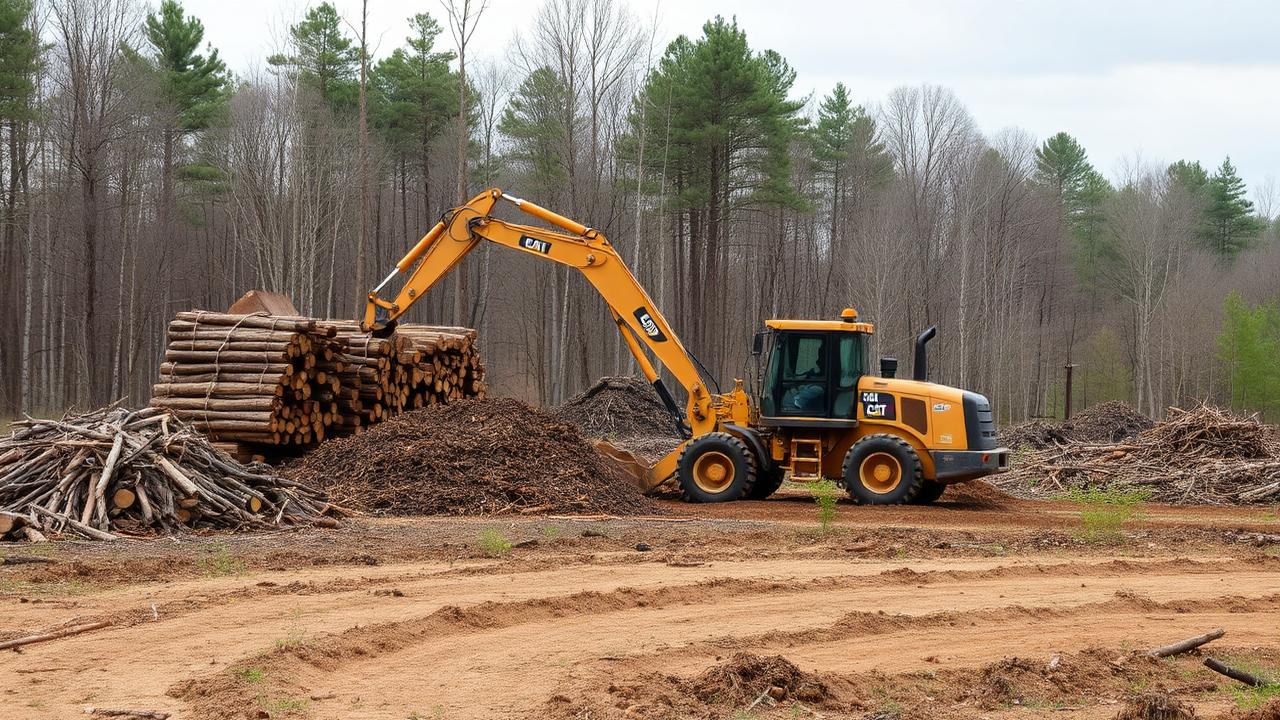
Whether you're prepping for a new build, pasture, or trail system, here's what a professional land-clearing project actually looks like on a Knox County property.
There's a reason people put off land clearing for years — it looks like a big, expensive, intimidating project. In practice it's one of the most predictable jobs we do, as long as the planning is right at the front end. Whether you're prepping a building site, opening pasture, putting in a driveway, or just reclaiming a corner of property that's been swallowed by multiflora rose and bush honeysuckle, here's what an actual land-clearing project looks like from the first phone call to the last load out.
Step 1: Site walk and goals
Every project starts with a walk. The biggest cost driver in land clearing isn't acreage — it's what's on the acreage. Two acres of bush honeysuckle and saplings is a completely different project than two acres of mature oak. We walk the lot together, talk about your goals (build site, pasture, food plot, view, trail system), flag anything you want preserved, identify property lines and setbacks, and look for the obvious complications — wet zones, slopes, rock outcrops, and any signs of buried utilities or old structures.
Step 2: Permits, locates, and regulatory check
Most agricultural and residential land clearing in Knox County doesn't require a permit. The exceptions are real and worth checking. Any project that disturbs more than one acre triggers Ohio EPA stormwater permitting and requires a written erosion and sediment control plan. Any work near a stream, wetland, or designated drainage course can require Army Corps jurisdiction review. Properties in CAUV or under a conservation easement have their own restrictions. We call OUPS for utility locates on every job, even on rural property, because gas lines and rural water lines aren't always where memory says they are.
Step 3: Picking the right approach
Three approaches handle 90% of what we do:
Forestry mulching
A tracked machine with a rotary mulching head grinds standing brush, saplings, and small trees in place. The output is a fine mulch left on the ground. No hauling, minimal soil disturbance, no stumps removed. Best for reclaiming overgrown ground, opening trails or food plots, and managing invasive species. Cheapest approach per acre and fastest. Not appropriate when you need clean grade for construction.
Brush hogging
A heavy rotary cutter behind a tractor mows down stems up to about 2-3 inches. Best for keeping previously cleared ground from regrowing, maintaining open fields, and routine brush hogging of property that doesn't get used. Doesn't handle trees, but it's the cheapest way to keep recovered ground recovered.
Traditional clearing with grubbing
Excavators and dozers fell, push, stump, and haul. The end product is bare graded ground ready for construction, septic installation, or final shaping. This is what you need for a building pad, a new driveway, or a septic field. Most expensive, most disruptive, and most necessary when the end use demands clean ground.
Step 4: Tree work where it makes sense
Larger trees — especially anything near a structure, fence, or property line — usually need to come down by tree removal crews before the heavy equipment starts. Trees with merchantable timber can sometimes be felled, decked, and sold to a logger, which can offset clearing costs on the right lot. We separate marketable hardwoods, firewood-grade material, and chip-grade material as we go, rather than pushing everything into a single burn pile.
Step 5: Stumps, brush, and debris
How stumps and debris are handled is where projects can run over budget if it's not nailed down up front. Options:
- Stumps ground in place — chips left on site, no hauling, fastest
- Stumps extracted — excavator pulls them out, root ball and all, then hauled or buried in an approved burial pit
- Brush piled and burned — cheapest if local burn rules allow
- Brush hauled to a processing facility — cleanest, most expensive
- Brush chipped on site — useful for trails or future landscaping mulch
We always quote the disposal method explicitly so there are no surprises.
Step 6: Grading, drainage, and erosion control
Once the brush and stumps are gone, the ground is rarely ready for the next step. Most cleared sites need rough grading to fill stump holes, remove ruts from machine traffic, and establish positive drainage. On sloped sites or sites near streams, we install silt fencing or straw wattles for erosion control until vegetation re-establishes. If the project includes a new driveway or building pad, this is where excavation and drainage work and driveway installation kicks in seamlessly.
Step 7: Final cleanup and stabilization
We pull equipment, do a walk-through with you, fix anything that wasn't right, and stabilize the ground. On pasture and field clearing, that's usually seeding with a cool-season mix appropriate for the use. On construction sites, it's leaving the pad ready for the foundation crew. On trail and recreation projects, it's making sure the lines flow the way you wanted.
Timing and weather
Late summer through early winter is the best season for most clearing work in Knox County — ground is firmest, leaves are off or coming off (visibility is better), and there's a clean window before spring rains. Spring clearing is possible but harder because tracked equipment ruts wet ground badly. We schedule larger projects months in advance and try to stack them with seasonal weather windows.
If you've been looking at an overgrown corner of your property — or a brushy lot you want to do something with — give us a call at (740) 485-2538. We'll walk it, talk through the approach, and quote a real number.