What does a new septic system actually cost in Knox County, and what should you expect from permit to backfill? Here's the full process, written for homeowners.
On a rural Knox County property, the septic system is one of the most important pieces of infrastructure on the lot — and one of the most expensive to get wrong. Whether you're building a new home, replacing a failed system, or buying a property that needs one, the questions are the same: what does it cost, how long does it take, and what should I expect from the process? Here's the full timeline, written from the installer's side of the table. Our septic installation crews go through this process several times a month, and very little of it is mysterious once it's broken down.
Step 1: Soil evaluation
Every Ohio septic system starts with a soil evaluation by a certified soil scientist. The evaluator digs or augers test pits, looks at the soil profile, and determines two things: the loading rate (how fast the soil can absorb wastewater) and the depth to any limiting layer like bedrock, fragipan, or seasonal water table. Those two numbers drive the entire design.
Knox County has wildly variable soils. We've installed conventional systems on sandy loam in one part of the county and aerobic treatment units a mile away on heavy clay over shale. You don't know what your site needs until the soil scientist has been there.
Step 2: System design
Based on the soil report, the system designer specifies tank size, drain field type and area, and any pretreatment required. Common designs in Knox County include:
- Conventional gravity systems — tank to drain field, no pump, on suitable soil
- Pressure-dosed systems — tank to pump chamber to drain field, used on tighter soils or where the field is uphill
- Mound systems — engineered sand mound above natural grade, used when seasonal water table is too high
- Aerobic treatment units — mechanical systems that pre-treat effluent before discharge, used on the toughest sites
- Drip distribution — small-diameter tubing for maximum dispersal area, used in tight or sloped sites
Step 3: Permit from the Knox County Health Department
The design package goes to the Knox County Health Department for review and permitting. Their review typically takes 2 to 4 weeks. Permit fees vary by system type but are usually a few hundred dollars. The health department also inspects the installation at multiple stages — typically when the tank is set, when the drain field is rough-graded, and again at final backfill — and the system can't be put into service until all inspections pass.
Step 4: Locating and protecting utilities
Before any digging, we mark out the work zone and call Ohio Utilities Protection Service (OUPS) at 811 for utility locates. On rural Knox County properties this is usually straightforward — gas, electric, and any private water lines. We also locate well casings to make sure all setback requirements are met. Ohio code requires specific minimum distances between septic components and wells, property lines, foundations, surface water, and other features.
Step 5: Excavation and tank installation
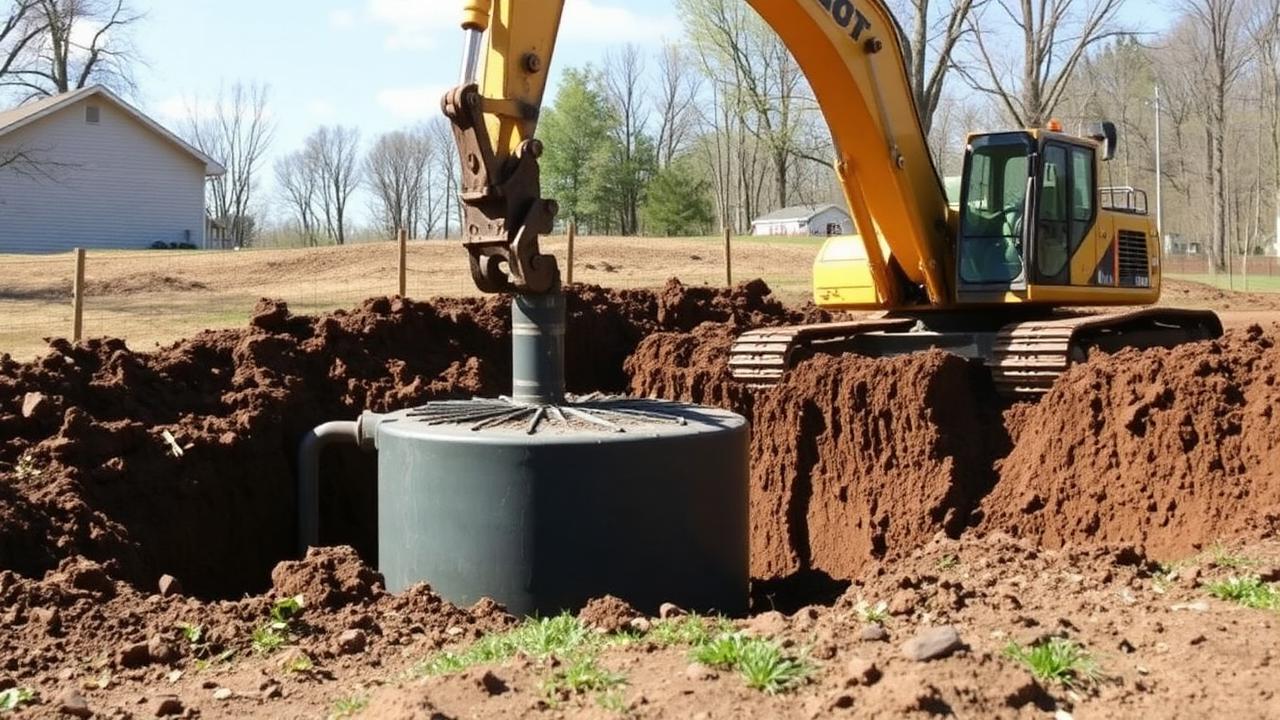
Installation begins with excavation for the tank and the drain field. We strip the topsoil separately and stockpile it for replacement at the end of the job — the difference between a yard that recovers in a season and one that's a mud pit for two years. The tank is set on a bed of compacted gravel, plumbed to the house with proper slope (typically 1/8 inch per foot), and the inlet baffle and outlet baffle are installed and tested.
Step 6: Drain field construction
Drain field construction is where most variation between installers shows up. We hand-rake the bottom of the trenches to avoid smearing the soil sidewalls (smearing creates a barrier that wastewater can't move through), use clean #57 stone as specified, lay perforated distribution pipe with the holes oriented correctly, and cover with geotextile fabric before backfill. The same job done sloppily — running a bucket along the trench bottom, skipping the fabric, dumping any old gravel — gives you a system that lasts 5 to 10 years instead of 25 to 30.
Step 7: Inspection and as-built
The health department inspector signs off at each stage and at final. We produce an as-built drawing showing tank locations, pipe runs, drain field layout, and clean-out access for future septic inspections. That as-built becomes part of the property record and is the document the next homeowner — or the next service tech — needs to find anything underground.
Step 8: Final grade and seeding
After final inspection, we backfill in lifts, replace topsoil, and rough-grade to drain water away from the system. We seed and straw the disturbed area, and on properties where the broader yard has also been affected by access routes for the excavator, we coordinate with the homeowner on regrading and reseeding the full work zone. On sites with drainage challenges, this is often combined with other excavation and drainage work to keep surface water away from the new field.
What it actually costs
Real numbers from recent Knox County installations: a conventional gravity system on good soil runs $8,000 to $12,000 turnkey including permit, design, and seeding. A pressure-dosed system on average soil runs $12,000 to $18,000. A mound system or aerobic treatment unit on a difficult site runs $20,000 to $35,000, occasionally higher. Variables that push the number up include long pipe runs, rock that has to be hammered or blasted, tight site access that requires smaller equipment, and replacement of an existing failed system (which adds tear-out costs).
Maintenance over the life of the system
A well-installed septic system needs surprisingly little. Pump the tank every 3 to 5 years (more often on larger households), keep heavy equipment off the drain field, don't plant trees within 30 feet of any drain line, and don't flush anything that isn't toilet paper. A system that's pumped on schedule and isn't abused commonly lasts 30 to 40 years. Most failures we see — and septic repair is a significant part of our work — come from skipped pumping or undetected drain field saturation that could have been caught at an inspection.
If you're planning a new build, replacing a failed system, or buying a Knox County property and want a real number, we're glad to do a free site walk. Give us a call at (740) 485-2538.