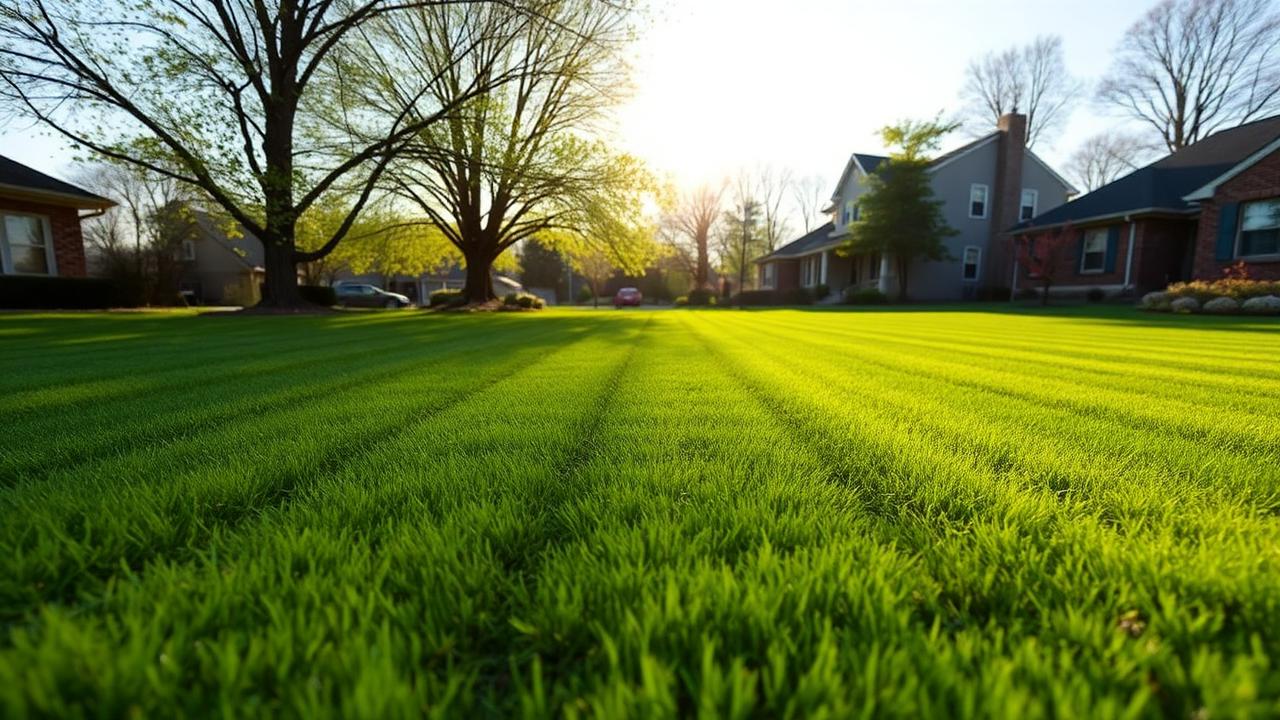
Cool-season grasses in Knox County need a different rhythm than the generic advice you'll find online. Here's the month-by-month plan we use on Danville-area lawns.
Lawn care advice on the internet is mostly written for someone else's climate. A Knox County lawn — Danville, Mount Vernon, Howard, Apple Valley, Gambier — is a cool-season lawn living in transition-zone weather. We get late freezes in April, drought weeks in July, and a long, generous fall window that's actually the best growing season of the year. The schedule below is what we follow on the homes we maintain, written for the real Ohio calendar instead of a generic one.
March: Wake the lawn up gently
March is patience month. The grass looks ready, but the soil usually isn't. Walking on a saturated lawn — or worse, mowing it — compacts the root zone for the rest of the year. Wait until you can step on the turf without leaving a footprint that holds. When you can, do a light cleanup pass: pick up sticks, rake matted leaves out of the corners, and look for areas where snow plows or salt killed strips along the driveway. Those are the spots that need attention first when temperatures rise.
April: First mow, pre-emergent, and patch repair
The first mow should happen when the grass is actively growing — usually mid to late April in Knox County. Set the deck to 3 inches for the first cut, then raise to 3.5–4 inches for the rest of the year. Sharpen the blade before that first pass. A dull blade tears the leaf tip, which browns within a day and looks like a fungus problem.
April is also the deadline for crabgrass pre-emergent. Watch forsythia: when the yellow blooms drop, soil temperatures are right at the threshold where crabgrass starts germinating. Get the pre-emergent down before that happens. Skip pre-emergent in any area you plan to overseed — you'll prevent your new grass from coming up too. For thin patches, this is also the time to slit-seed bare spots that didn't recover from winter, as part of regular landscape maintenance.
May: Mow weekly, fertilize lightly, watch for grubs
Growth peaks in May. Mow weekly — or more often if you've had warm rain — and never remove more than a third of the blade in one pass. If the lawn got ahead of you, raise the deck and bring it down in two cuts a few days apart. Side discharge is fine; you don't need to bag clippings. Mulched clippings return nitrogen and slow water loss in the heat that's coming.
A light spring fertilizer is helpful but not essential — the big nitrogen push belongs in fall, not spring. If you do fertilize, choose a slow-release product and apply at the lower end of the label rate. Heavy spring nitrogen pushes lush top growth that the roots can't support when July arrives.
June: Set the mowing height for summer
Raise the deck to 3.5 or 4 inches and leave it there until fall. Taller grass shades the soil, holds moisture, and shades out crabgrass seedlings the pre-emergent missed. If you have irrigation, water deeply and infrequently — one inch per week, in two soakings, early morning. Daily light watering trains shallow roots that die in the first dry week.
July and August: Don't fight dormancy
Cool-season grass is genetically programmed to slow down in midsummer heat. A lawn that browns slightly in late July is not a sick lawn — it's a healthy one conserving energy. Don't fertilize. Don't apply weed control on a stressed lawn. Mow less often, raise the deck even higher if you're going through a heat wave, and keep the blade sharp. If your lawn is irrigated, an inch a week is plenty.
August is also when grub damage shows up. Look for irregular brown patches that pull up like loose carpet. If you find more than 6–10 grubs per square foot under the sod, treat the affected area. Otherwise let the natural population stay.
September: The most important month of the year
If you only do one thing for your lawn, do it in September. Soil is warm, air is cooling, and competition from weeds collapses. This is the window for core aeration and overseeding. Pull cores (not solid tines), drop a quality seed blend appropriate for sun or shade, and topdress lightly with screened compost if you can. Water lightly twice a day for the first two weeks, then back off as the seedlings root in. A September overseed gives you grass thick enough to crowd out weeds for the next two years.
September is also the right time for the fall fertilizer application. A balanced slow-release product builds root mass — the part of the plant you can't see, but the part that determines how the lawn survives next summer.
October: Keep mowing, start clearing leaves
Don't stop mowing in October just because the calendar flipped. Grass keeps growing until soil temperatures consistently drop below 50°F — usually early November here. Drop the mowing height gradually to about 2.5 inches by the last cut of the year so matted leaves and snow have less to grip.
Stay on top of leaves. A light layer mulched in by the mower is fine — even helpful. Heavy wet leaves left in place will smother the lawn and create perfect conditions for snow mold. If you have mature trees and the leaves get ahead of you, schedule fall cleanup before the first snow.
November: The winterizer that actually matters
A late-fall (winterizer) fertilizer applied just before the grass goes dormant is one of the highest-impact things you can do. The plant stores the nitrogen in the crown over winter and uses it for explosive green-up next spring — without the lush top growth that a heavy spring application produces. Apply it after the last mow but before the ground freezes.
December through February: Stay off it
Frozen and dormant turf is fragile. Foot traffic on a frosted lawn crushes the crowns and leaves dead tracks visible the following spring. Park trailers, firewood, and equipment somewhere else. Beyond that, the lawn doesn't need you for these three months — focus on planning next year's beds, mulch refresh, or any landscape design and installation you've been putting off.
What we do differently on the lawns we maintain
Most weekly mowing services in Knox County run the same pattern, at the same height, every week — which compacts soil into permanent ruts and scalps the high spots. We rotate mowing directions, adjust deck height to the season, and sharpen blades on a real schedule (not when someone notices). On properties where we manage the full season, we also coordinate the bigger work — mulching and planting, aeration, leaf cleanup, and the winterizer — so the lawn always has what it needs when it needs it, not three weeks too late.
If you'd like a calendar built around your specific property — sun exposure, soil type, irrigation, and how you actually use the yard — give us a call at (740) 485-2538. Free estimates, honest scheduling, and no surprise upsells.