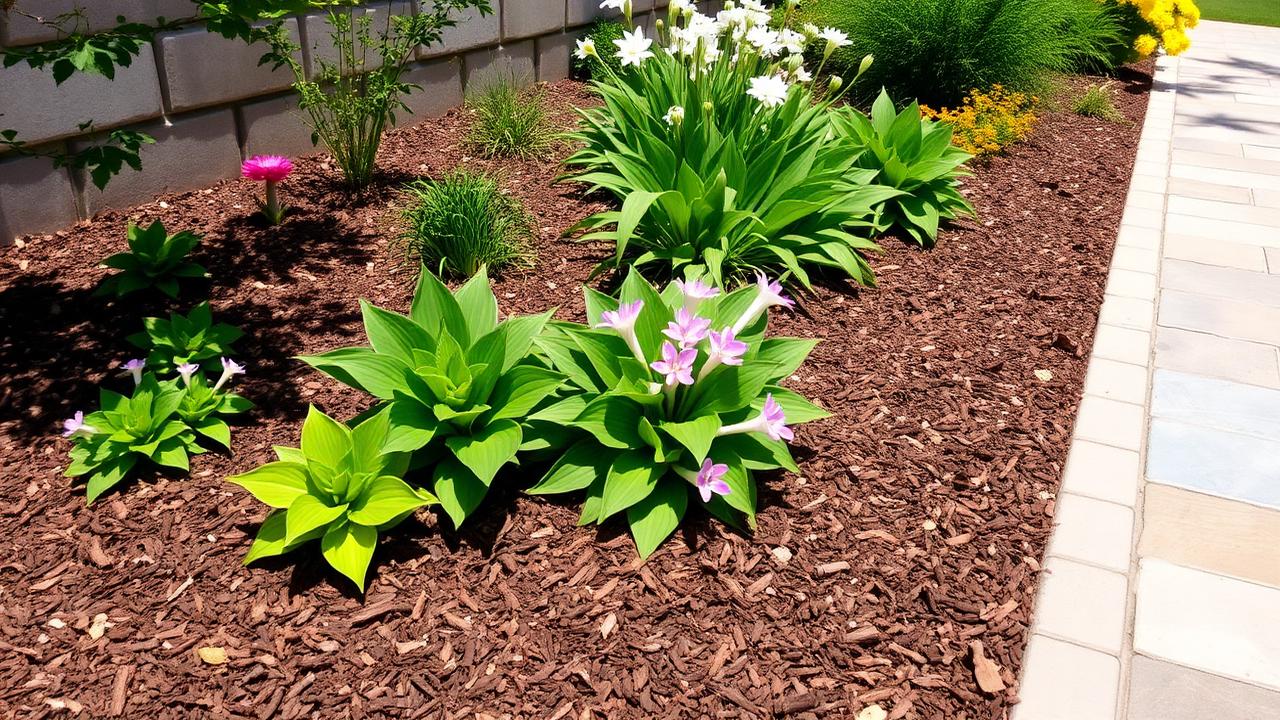
Mulch math is simpler than the calculators make it look. Here's how to measure your beds, pick the right depth, and choose a product that actually lasts the season.
Every spring we get the same question from new clients: how many yards of mulch do I order? The online calculators give you an answer, but they all assume your beds are perfect rectangles and that the mulch will land exactly where you measured. In the real world it never does. Here's the way we actually estimate it on the properties we mulch and plant every year.
Start with the right depth, not the area
Two to three inches is the sweet spot. Anything less and weed seeds blow in, sun bakes the soil, and you'll be hauling another yard out in July. Anything more — especially the dreaded 'mulch volcano' piled against tree trunks — and you create rot, vole tunnels, and surface roots that wrap and strangle the tree.
If your beds were mulched last year, you're top-dressing, not installing. That means you only need to add the depth needed to bring the existing layer back up to roughly 3 inches. On most established beds in Knox County, that's about an inch and a half of new mulch — half what a calculator would tell you to order if it assumes a bare-soil install.
The math, in one paragraph
Measure the square footage of each bed (length × width — round irregular beds to whatever rectangle they roughly fit inside). Multiply total square footage by the depth in inches, then divide by 324. That number is your cubic yards. Example: 600 square feet of beds × 2 inches deep ÷ 324 = 3.7 cubic yards. Round up to 4 and you have a small buffer for spreading losses.
Yard vs bag, and when each makes sense
Bagged mulch from a big-box store runs about 2 cubic feet per bag, so it takes 13.5 bags to equal one cubic yard. For a typical Danville home with 4 yards of beds, that's 54 bags. The bags cost roughly two to three times what bulk mulch costs delivered, and you'll spend a Saturday hauling them. Bulk is almost always cheaper and faster over about 2 yards. Bags are fine for a single tight bed or a topdress touch-up.
Choosing the product: hardwood, dyed, or pine
Natural double-shredded hardwood is the default in central Ohio for a reason. It locks together on slopes, breaks down into the soil over the season, and ages to a soft gray-brown that looks intentional rather than tired. It also costs less than dyed varieties.
Dyed mulch (black, brown, or red) holds its color longer — usually most of a season — and pops visually against green plants and stone. The dye itself is safe; the concern is that some lower-grade dyed products are made from ground-up pallet wood, which has less organic value when it breaks down. Buy from a yard that sources hardwood and dyes it, not the other way around.
Pine bark and pine straw both have their fans. Pine bark nuggets float and migrate in heavy rain — we generally don't recommend them on a slope. Pine straw works beautifully under azaleas and rhododendrons and acidifies the soil slightly as it breaks down, but it isn't traditional in this part of Ohio.
Timing: when to mulch in Knox County
Wait until the soil has warmed — generally mid to late April here. Mulching cold soil in late March keeps it cold, which delays perennial emergence and pushes back your bloom calendar by a couple of weeks. A second light topdress in early summer keeps color fresh through fall and replaces what's compacted down.
Edging makes mulch look twice as good
A clean, crisp bed edge — cut with a spade or a powered edger — does more for curb appeal than the mulch itself. A 3–4 inch deep trench edge between the mulch and the lawn keeps mulch in the bed, gives the mower wheel a place to ride, and frames the planting. We cut a fresh edge every spring as part of our landscape maintenance service, and it's the single highest-impact 30 minutes you can spend on a bed.
Common mulch mistakes we see every spring
- Mulch volcanoes against tree trunks. Pull mulch back so the root flare is visible — never piled against bark.
- Too thick on perennials. Three inches over a sleeping hosta in April keeps it sleeping in May.
- Plastic underlayment. Landscape fabric breathes; black plastic suffocates the soil and turns beds into anaerobic mud.
- Mulching weeds instead of pulling them. Mulch suppresses germination; it doesn't kill established weeds. Pull, then mulch.
- Skipping the edge. A mulched bed without an edge looks unfinished no matter how nice the product is.
When mulch is part of a bigger plan
On new construction or a tired yard, mulch is usually the last step of a larger landscape design and install — beds shaped, soil amended, plants in, edges cut, then mulched. Done in that order, the mulch reads as the finishing touch rather than a layer hiding bad bones. If your beds need more than fresh mulch — if the layout no longer works, or you want low-maintenance options like a rock garden — get the design right first and the mulch math becomes a footnote.
If you'd rather skip the calculator and have someone measure, deliver, and spread, give us a call at (740) 485-2538. We mulch homes across Danville, Mount Vernon, Howard, Apple Valley, and the broader Knox County area every spring.