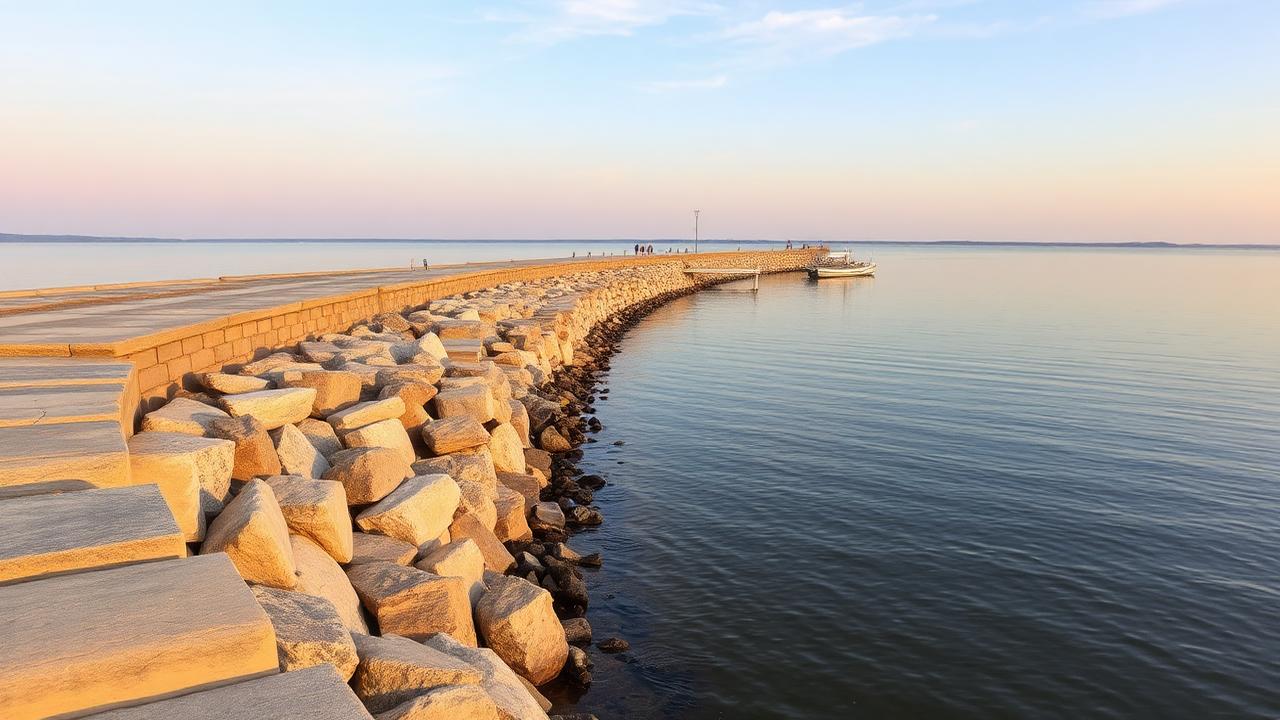
A failing seawall doesn't usually announce itself with a collapse — it gives warning signs first. Here's what to look for, and when to call before erosion takes the yard.
Living on Apple Valley Lake, Knox Lake, or one of the other Knox County lakes is one of the real perks of life in this part of Ohio. The trade-off is the seawall — the one piece of your property that's holding back constant pressure from two directions. Water in front, soil behind, and freeze-thaw working on both. Seawalls don't usually fail dramatically. They fail gradually, give warnings, and then one wet spring the failure shows up all at once. Knowing the early signs is the difference between a $5,000 seawall repair and a $50,000 rebuild plus a yard's worth of lost soil.
1. Visible lean toward the lake
Stand at the corner of your seawall and sight along the top. A new wall is straight or built with intentional batter (a slight lean back toward the yard). If your wall is leaning forward — toward the water — by even an inch or two over a 20-foot run, it's moving. Walls that have leaned slightly can sometimes be stabilized with tieback anchors driven through the wall into deadmen buried in the yard. Walls that have leaned significantly almost always need to be rebuilt before they collapse.
2. Soil disappearing from behind the wall
Walk the yard side of the seawall every spring. Look for soft spots, sinkholes, or sections where the lawn has dropped an inch or two below the rest of the grade. That means soil is washing out from behind the wall — either through cracks in the wall itself, through joints that have separated, or under the wall through erosion at the base. Once the soil starts disappearing, the wall has nothing to hold back, and the structural failure follows. This is the single most predictive sign of upcoming collapse.
3. Cracks running vertically or diagonally
Hairline cracks in concrete or mortar are normal and usually cosmetic. Wider cracks — anything you can fit a credit card into — are structural. Diagonal cracks running corner-to-corner across a panel mean the wall is being stressed unevenly. Vertical cracks at panel joints often mean differential settlement between sections. Either way, get those documented with photos and watch them. A crack that grows over a season is a wall on a clock.
4. Bulging or bowing sections
Look at the wall face from a small boat or from down the shoreline. A wall that has started to bow outward — usually in the middle third — is being pushed by saturated soil behind it. By the time bulging is visible, the hydrostatic pressure has overcome the wall's structural capacity. Bulging walls do not heal. They get worse, and the worse they get, the faster they progress.
5. Cap stones or coping that have shifted
The cap is the easiest place to spot movement. If your cap stones are no longer level — if one has dropped, lifted, or rotated relative to its neighbors — the wall below it is moving. On stone seawalls, missing or loose cap stones also let water pour straight down into the backfill, which accelerates the washout problem.
6. Rot or hollow spots on timber walls
Treated timber seawalls have a fixed lifespan — usually 15 to 25 years in this climate. The lake side looks fine long after the yard side has rotted. Probe the timbers with a screwdriver in early spring. If the tip sinks more than a quarter inch into the wood with light pressure, that timber is no longer load-bearing. A timber wall with even one rotted course is on borrowed time.
7. Erosion at the base, exposed footings, or undermining
Drop the water level mentally and look at the bottom of the wall. Is there a cavity where waves have scooped soil out from beneath? Is the footing exposed? Is the wall sitting on a smaller and smaller pad than it was built on? Undermining is one of the harder failure modes to fix because it requires drying out the work zone — usually with cofferdams, sand bags, or seasonal low water — before any repair can be made. Catching it early is much cheaper than catching it late.
What causes seawalls to fail
Almost every seawall we replace failed for the same reason: water moving from the yard side toward the lake side without a path out. Downspouts dumping at the top of the slope, lawn irrigation overspraying the backfill, and grade tilted toward the wall all add water the wall was never designed to hold. The solution is usually some combination of regrading, drain tile behind the wall, and rerouting gutters — work that overlaps with our excavation and drainage services on the broader property.
Repair vs replacement: how we evaluate
When we walk a seawall, we're looking at the same questions in order: is the wall structurally intact, is the backfill still in place, and is the drainage working? If two of those three are yes, repair is usually viable — patching cracks, reseating caps, replacing isolated panels, or adding tiebacks. If two of three are no, the right answer is almost always to rebuild the failing section properly, with new drainage behind it, rather than patch a wall that's going to keep failing.
Timing and access matter
The best window for seawall work on Knox County lakes is late summer through early fall, when water levels are at their lowest and the ground is firm enough to support equipment. Spring repairs are possible but harder. If you noticed warning signs this season, the right move is usually to get on the schedule now for next fall — both because lead times for materials and engineering are real, and because access is limited to a few months of the year.
If you're seeing any of these signs on your Apple Valley, Knox Lake, or other Knox County waterfront property, we'd be glad to walk it with you and tell you honestly what we see. Give us a call at (740) 485-2538.